Appendix: Tree Normal Form
Tree grouping bridges two worlds: the relational (flat, tabular, join-oriented) and the hierarchical (nested, tree-structured, document-oriented). Not all JSON has a sensible relational interpretation – arbitrary nesting can be too irregular to map cleanly. But some trees do, and understanding which ones helps clarify what tree grouping actually computes.
This appendix defines tree normal forms – a vocabulary for describing JSON structure and its relational interpretation. Unlike database normal forms (which form a linear hierarchy), tree normal forms are organized as a graph. Nodes are forms; edges are constraints or interpretations. Some edges restrict structure; others assign meaning to nesting.
The Graph
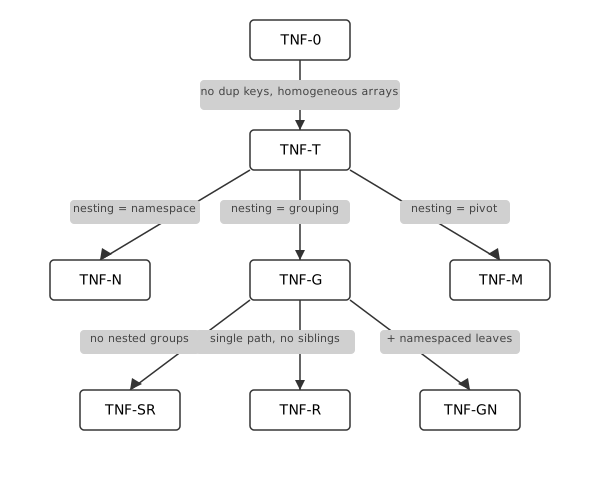
Edges represent:
| Edge | Type | Meaning |
|---|---|---|
| TNF-0 → TNF-T | Restriction | Structural hygiene |
| TNF-T → TNF-N | Interpretation | Nesting means namespacing |
| TNF-T → TNF-G | Interpretation | Nesting means grouping |
| TNF-T → TNF-M | Interpretation | Nesting means pivot |
| TNF-G → TNF-SR | Restriction | No nested groups (flat) |
| TNF-G → TNF-R | Restriction | Single path, no siblings |
| TNF-G → TNF-GN | Combination | Grouping with namespaced leaves |
Tree normal form edge types
The graph admits extension. New forms slot in by defining their edges.
The Forms
TNF-0: Valid JSON
The baseline: any valid JSON per RFC 7159.
- Keys may be duplicated
- Arrays may be heterogeneous
- Top-level value may be a scalar
- Objects may be empty
Relational interpretation: None guaranteed. This is raw material. But it’s still queryable – pathing and json_each work on any valid JSON.
TNF-T: Well-Typed JSON
Restriction from TNF-0: no duplicate keys, homogeneous arrays, non-empty objects, array or object at top level.
Relational interpretation: Arrays can be interpreted as collections; objects as records. Pathing is unambiguous. But nesting semantics are not yet defined – is a nested object a namespace? A grouped row? A pivot?
TNF-T is the foundation for the interpretive forms that follow.
TNF-N: Namespaced
Interpretation from TNF-T: nesting means semantic organization.
Nested objects group related fields – structure, not data rows.
The address object is a namespace. The tree is semantically equivalent to:
Relational interpretation: Namespaced trees flatten to a single row. Pathing (.address.city) navigates the namespace.
Trade-off: More expressive (preserves semantic grouping) but less directly relational (requires flattening).
TNF-G: Grouped
Interpretation from TNF-T: nesting means aggregation.
Arrays represent grouped rows – the result of GROUP BY.
[
  { "title": "Engineer",
    "people": [
      { "first_name": "Alice", "last_name": "Smith" },
      { "first_name": "Bob", "last_name": "Jones" }
    ]
  },
  { "title": "Manager",
    "people": [
      { "first_name": "Carol", "last_name": "White" }
    ]
  }
]
Each nesting level is a grouping context. The outer array groups by title; the inner people array collects rows within each title.
Relational interpretation: Direct correspondence to GROUP BY. Construction compresses cardinality; destructuring expands it.
TNF-M: Metadata-Keyed
Interpretation from TNF-T: nesting means pivot.
Data values become object keys.
{
  "Engineer": [
    { "first_name": "Alice", "last_name": "Smith" }
  ],
  "Manager": [
    { "first_name": "Carol", "last_name": "White" }
  ]
}
The keys (Engineer, Manager) are data values lifted to metadata.
Relational interpretation: Keys map to a column; values map to grouped rows. Destructuring recovers the key as a column value.
Trade-off: Convenient for lookup but constrained – only one column can serve as keys per level. Two metadata-keyed objects with the same key type create ambiguous destructuring.
TNF-SR: Simply Relational
Restriction from TNF-G: no nested groups.
A flat array of homogeneous objects – the simplest grouped form.
[
  { "title": "Engineer", "first_name": "Alice", "last_name": "Smith" },
  { "title": "Engineer", "first_name": "Bob", "last_name": "Jones" },
  { "title": "Manager", "first_name": "Carol", "last_name": "White" }
]
No nested arrays. Each object is a row; the array is a table.
Relational interpretation: Direct. The JSON is a table in array-of-objects form. No grouping, no hierarchy – just rows.
TNF-R: Round-Trippable
Restriction from TNF-G: single path from root to deepest leaf, no sibling groups.
[
  { "title": "Engineer",
    "state": "CA",
    "people": [
      { "first_name": "Alice", "last_name": "Smith" }
    ]
  }
]
Relational interpretation: Lossless. relation → tree → relation recovers the original data (modulo column order).
Why siblings break round-tripping:
Siblings aggregate independently. The join – which person was in which city – is not preserved. Destructuring recovers each path independently:
country,first_name,last_name(viapeople)country,city(viacities)
But not the original four-column row. This is TNF-G but not TNF-R.
TNF-GN: Grouped with Namespaced Leaves
Combination of TNF-G and TNF-N: grouping structure with namespaced leaf objects.
[
  { "title": "Engineer",
    "people": [
      { "name": { "first": "Alice", "last": "Smith" },
        "contact": { "email": "[email protected]", "phone": "555-1234" }
      }
    ]
  }
]
The outer structure is grouped (array of objects with nested arrays). The leaf objects use namespacing (name, contact).
Relational interpretation: Destructure the grouping levels; flatten the namespaced leaves. The result has columns title, name_first, name_last, contact_email, contact_phone.
Mixing Forms
Real trees often combine forms at different levels. The graph shows which combinations make sense:
{
  "metadata": {
    "generated": "2024-01-15",
    "version": "1.0"
  },
  "data": [
    { "title": "Engineer",
      "people": [
        { "first_name": "Alice", "last_name": "Smith" }
      ]
    }
  ]
}
metadatais TNF-N (namespacing)datais TNF-G (grouping)
The relational interpretation:
- Flatten
metadata.generated,metadata.versionto columns - Destructure
data→data.peopleto rows - Result: one row per person, metadata fields repeated
Understanding which form applies where clarifies what operations make sense.
Edge Types
The graph has two kinds of edges:
Restriction edges add structural constraints: - TNF-0 → TNF-T: hygiene (no dup keys, homogeneous arrays) - TNF-G → TNF-SR: flatness (no nested groups) - TNF-G → TNF-R: single-path (no siblings)
Interpretation edges assign meaning to structure: - TNF-T → TNF-N: nesting is namespacing - TNF-T → TNF-G: nesting is grouping - TNF-T → TNF-M: nesting is pivot
Restriction edges constrain what trees are valid. Interpretation edges determine how to read them relationally.
Summary
| Form | Key Property | Relational Interpretation |
|---|---|---|
| TNF-0 | Valid JSON | None guaranteed; queryable via pathing |
| TNF-T | Well-typed | Arrays are collections; objects are records |
| TNF-N | Namespaced | Flatten to single row |
| TNF-G | Grouped | GROUP BY; destructure to rows |
| TNF-M | Metadata-keyed | Pivot; keys become column values |
| TNF-SR | Simply relational | Direct table (array of flat objects) |
| TNF-R | Round-trippable | Lossless construction/destruction |
| TNF-GN | Grouped + namespaced | Destructure groups, flatten namespaces |
Summary of tree normal forms
The forms answer different questions:
- TNF-0 / TNF-T: Is this JSON structurally sound?
- TNF-N / TNF-G / TNF-M: What does nesting mean here?
- TNF-SR / TNF-R: How constrained is the grouping?
- TNF-GN: Can I mix interpretations?
Tree normal forms are not prescriptive – TNF-0 is sometimes exactly what you need. They are a vocabulary for understanding what your tree structure means relationally, and what operations it supports.
Extending the Graph
The graph admits new forms by defining edges. Examples:
- TNF-MR (metadata-keyed, round-trippable): TNF-M + single-path constraint
- TNF-SN (simply namespaced): TNF-N + flat (no nested namespaces)
- TNF-GM (grouped + metadata): grouping with metadata-keyed intermediate levels
Each new form names a useful combination.
Guiding Principles
-
Trees and tables mix. Trees have a valid relational interpretation under certain structural constraints.
-
Start with relations. The cleanest trees arise from grouping relations, not from arbitrary JSON. Construction informs understanding.
-
Arrays are rows; objects are records. Arrays represent homogeneous collections (multiple rows of the same shape). Objects represent heterogeneous structure (named fields, like columns).
-
Grouping compresses; destructuring expands. Construction decreases cardinality (many rows → fewer rows with nested arrays). Destructuring increases cardinality (nested arrays → many rows).
-
Siblings lose information. Sibling tree groups aggregate independently. The relationship between siblings – which person was in which city – is not preserved. This is inherent, not a bug.
-
Metadata-oriented trees are pivots. When data values become object keys, the structure resembles a pivot table. This helps with the object-relational impedance mismatch but introduces constraints.
-
Zeroth normal form has its place. Arbitrary JSON can still be queried via
json_eachand pathing. Tree normal forms define what’s cleanly relational, not what’s queryable at all.